` to derive unique per-leg keys within 20 chars) |
| Sum of `volumePercent` across legs | ≤ **100** |
| Per-leg `takeProfit` | Required on every entry |
| `volume` vs `volumePercent` | Mutually exclusive per leg |
#### Response Shape
The HTTP response stays backward compatible:
* The top-level `requestId` is the **first leg's** request id.
* `data.subRequestIds` lists every leg id in order.
* `data.legCount` is the total number of legs created.
Use the leg ids with `GET /requests/{requestId}/status` to track per-leg delivery and execution.
#### Managing Legs After Open
Each leg behaves like a normal position once opened. To modify or close a specific leg, use its derived `tradeKey`:
```json
{
"secret": "your_secret_minimum_16_chars",
"action": "modify",
"tradeKey": "xau_long_001_t2",
"stopLoss": 4460
}
```
To act on **all legs at once**, group them with a shared `magicNumber` on the parent request and use [`matchMode: GROUP`](#close-by-magic-number-group):
```json
{
"secret": "your_secret_minimum_16_chars",
"action": "open",
"symbol": "XAUUSD",
"orderType": "buy",
"volume": 0.06,
"stopLoss": 4455,
"tradeKey": "xau_long_001",
"magicNumber": "770001",
"takeProfits": [
{ "takeProfit": 4470 },
{ "takeProfit": 4480 },
{ "takeProfit": 4495 }
]
}
```
```json
{
"secret": "your_secret_minimum_16_chars",
"action": "close",
"matchMode": "GROUP",
"magicNumber": "770001",
"force": true
}
```
{% hint style="info" %}
**Why use this instead of sending multiple webhooks?** A single request avoids the race between concurrent webhook calls hitting the broker. Each leg is reserved with a unique `tradeKey` and submitted through the same queue, so partial drops under bursts no longer happen.
{% endhint %}
***
### Close Action
Closes position(s) based on matching criteria.
#### Match Modes
| Mode | Matches By | Description |
| ------- | -------------------------- | ---------------------------------------------- |
| `EXACT` | `tradeKey` | Close specific position(s) from stored mapping |
| `GROUP` | `magicNumber` or `orderId` | Close positions by strategy group |
| `BULK` | `symbol` | Close all positions for a symbol |
{% hint style="info" %}
If `matchMode` is not provided, it's auto-detected based on which fields you include.
{% endhint %}
{% hint style="warning" %}
**An explicit `matchMode` overrides auto-detection and the other identifiers are ignored.** If you send `"matchMode": "GROUP"` together with a `tradeKey`, the `tradeKey` is not used at all and only `magicNumber` / `orderId` decide which positions match. If nothing matches you get `POSITION_NOT_FOUND`, even though the `tradeKey` exists.
To match a single position by its `tradeKey`, either omit `matchMode` entirely or set it to `"EXACT"`.
{% endhint %}
#### Close by TradeKey (EXACT)
```json
{
"secret": "your_secret",
"action": "close",
"tradeKey": "my_trade_001"
}
```
#### Close by Magic Number (GROUP)
```json
{
"secret": "your_secret",
"action": "close",
"matchMode": "GROUP",
"magicNumber": "150001",
"closeMode": "all"
}
```
#### Close by Symbol (BULK)
```json
{
"secret": "your_secret",
"action": "close",
"matchMode": "BULK",
"symbol": "EURUSD",
"direction": "long",
"closeMode": "first"
}
```
#### Close Fields
| Field | Type | Description |
| ------------- | ------- | --------------------------------------------------------------------------------------------------------------------------------------------- |
| `matchMode` | string | `EXACT`, `GROUP`, or `BULK` (auto-detected if omitted). An explicit value overrides auto-detection |
| `tradeKey` | string | Position identifier (EXACT mode). Ignored if `matchMode` is `GROUP` or `BULK` |
| `magicNumber` | string | Strategy identifier, digits only (GROUP mode). Reliable: never truncated |
| `orderId` | string | Strategy order ID (GROUP mode). Matched inside the comment, so it can be lost to [comment truncation](#truncation-proof-grouping-magicnumber) |
| `symbol` | string | Trading pair (BULK mode) |
| `direction` | string | `long` or `short` filter (BULK mode) |
| `closeMode` | string | `first`, `last`, or `all` (default: `all`) |
| `force` | boolean | Allow closing more than `maxMatchCount` positions |
#### Close Modes
| Value | Description |
| ------- | ---------------------------- |
| `first` | Close oldest position (FIFO) |
| `last` | Close newest position (LIFO) |
| `all` | Close all matching positions |
#### Force Flag
If more than `maxMatchCount` positions match, you must either:
1. Add `force: true` with explicit `matchMode`
2. Add more specific filters
This prevents accidental bulk operations.
***
### Cancel Order Action
Cancels **pending order(s) only** (unfilled Limit/Stop orders). Live (already filled) positions are **never** affected. Uses the **exact same matching options as `close`** (`tradeKey` / `magicNumber` / `orderId` / `symbol` + `direction` / `closeMode` / `matchMode`).
{% hint style="info" %}
**Why this exists.** If you manage pending-order expiry with your own timer and send `close` when it fires, a `close` would also close the position if the order was **already filled** in the meantime. `cancelOrder` removes that risk: it only ever cancels pending orders. If the order already filled (or no longer exists), the request is a **safe no-op** (success, nothing cancelled) rather than an error.
{% endhint %}
**Cancel by TradeKey (EXACT):**
```json
{
"secret": "your_secret",
"action": "cancelOrder",
"tradeKey": "my_trade_001"
}
```
**Cancel a pending order for a symbol (BULK):**
```json
{
"secret": "your_secret",
"action": "cancelOrder",
"matchMode": "BULK",
"symbol": "EURUSD",
"direction": "long"
}
```
{% hint style="warning" %}
`cancelOrder` is a distinct action string. If you restrict `allowedActions`, add `"cancelOrder"` to the list (leaving `allowedActions` empty allows all actions).
{% endhint %}
{% hint style="success" %}
**Native alternative:** For MT4/MT5 you can skip the external timer entirely by setting `pendingExpirySeconds` on the `open` payload. See [Pending Order Expiry](#pending-order-expiry).
{% endhint %}
***
### Pending Order Expiry
Set `pendingExpirySeconds` on an `open` request to give a pending order (`buyLimit`, `sellLimit`, `buyStop`, `sellStop`) a **native broker-side expiry**. The broker cancels the order automatically if it has not been filled within that time. No follow-up webhook is needed.
```json
{
"secret": "your_secret",
"action": "open",
"symbol": "EURUSD",
"orderType": "buyLimit",
"volume": 0.1,
"openPrice": 1.0800,
"pendingExpirySeconds": 3600
}
```
{% hint style="info" %}
* Only applies to **pending orders** on **MT4/MT5**. It is ignored for market orders (`buy`/`sell`) and for account types that do not support broker-native expiry.
* `0` or omitted means **good-till-cancelled** (no expiry).
* Enforcement is **broker-dependent**: some brokers require a minimum expiry (often at least a few minutes) or do not allow pending order expiry at all. If the broker rejects the expiry, the order is placed without one.
* Because the broker owns the timer, expiry works even if it fires long after the alert; there is no race with a fill (a filled order simply stays open).
* Prefer this over an external timer + `cancelOrder` when your account is MT4/MT5. Use `cancelOrder` for manual/early cancellation or on connectors without native expiry.
{% endhint %}
***
### Modify Action
Modifies existing position(s). Supports `EXACT` (tradeKey), `GROUP` (magicNumber / orderId), and `BULK` (symbol) matching - same modes as the close action.
**Modify a single position by tradeKey (EXACT):**
```json
{
"secret": "your_secret",
"action": "modify",
"tradeKey": "my_trade_001",
"stopLoss": 1.0850,
"takeProfit": 1.0980
}
```
**Modify all positions sharing a magicNumber (GROUP):**
```json
{
"secret": "your_secret",
"action": "modify",
"matchMode": "GROUP",
"magicNumber": "150001",
"stopLoss": 1.0820,
"takeProfit": 1.0960
}
```
**Modify all positions sharing a strategy orderId (GROUP):**
```json
{
"secret": "your_secret",
"action": "modify",
"matchMode": "GROUP",
"orderId": "Long Entry",
"stopLoss": 1.0820
}
```
**Modify all open positions on a symbol (BULK):**
```json
{
"secret": "your_secret",
"action": "modify",
"matchMode": "BULK",
"symbol": "EURUSD",
"stopLoss": 1.0820
}
```
{% hint style="info" %}
If a `modify` request matches more than `maxMatchCount` positions, the request is rejected with `AMBIGUOUS_MATCH`. Add `force: true` together with an explicit `matchMode` to proceed. This safety guard mirrors the `close` action.
{% endhint %}
#### Partial Close
```json
{
"secret": "your_secret",
"action": "modify",
"tradeKey": "my_trade_001",
"reduceVolumeBy": 0.05
}
```
{% hint style="info" %}
If `reduceVolumeBy` reduces the position to 0 or below, the position is fully closed.
{% endhint %}
{% hint style="warning" %}
`reduceVolumeBy` is only supported in `EXACT` mode (matching by `tradeKey`). It is rejected in `GROUP` and `BULK` modes because "reduce by X" is ambiguous across multiple positions (per-position vs. total group exposure). To reduce volume for several positions, send one `modify` per `tradeKey`.
{% endhint %}
#### Modify Fields
| Field | Type | Description |
| ---------------- | ------- | --------------------------------------------------------------------------------------------------------------------------------------------- |
| `matchMode` | string | `EXACT`, `GROUP`, or `BULK` (auto-detected). An explicit value overrides auto-detection |
| `tradeKey` | string | Position identifier (EXACT mode). Ignored if `matchMode` is `GROUP` or `BULK` |
| `magicNumber` | string | Strategy identifier, digits only (GROUP mode). Reliable: never truncated |
| `orderId` | string | Strategy order ID (GROUP mode). Matched inside the comment, so it can be lost to [comment truncation](#truncation-proof-grouping-magicnumber) |
| `symbol` | string | Trading pair (BULK mode) |
| `force` | boolean | Allow modifying more than `maxMatchCount` positions |
| `stopLoss` | number | New stop loss price (absolute price only, not points) |
| `takeProfit` | number | New take profit price (absolute price only, not points) |
| `openPrice` | number | New price for pending orders |
| `reduceVolumeBy` | number | Volume to reduce (partial close) |
***
### CloseAll Action
Closes ALL positions on the account.
```json
{
"secret": "your_secret",
"action": "closeAll",
"force": true
}
```
**Requirements:**
* Feature must have `allowCloseAll: true`
* Request must have `force: true`
{% hint style="warning" %}
This closes every open position on the account!
{% endhint %}
***
### Store Action
Stores custom data from TradingView strategies/indicators.
```json
{
"secret": "your_secret",
"action": "store",
"data": {
"symbol": "EURUSD",
"rsi": 72.5,
"macd": 0.0012,
"signal": "overbought"
}
}
```
| Field | Required | Type | Description |
| ------ | -------- | ------ | ----------------------------------------- |
| `data` | ✅ | object | Any JSON object to store (max 100KB size) |
Data is stored in Database with TTL based on `dataRetentionDays`.
{% hint style="warning" %}
The `data` object has a maximum size limit of **100KB**. Requests exceeding this limit will be rejected.
{% endhint %}
#### Retrieve Stored Data
Use the REST API to fetch stored data:
**List all stored data (paginated):**
```
GET /rest/api/v1/webhooks/tradingview/accounts/{accountId}/data?limit=50&skip=0
```
Response:
```json
{
"data": [
{
"id": "65abc123...",
"accountId": "your-account-id",
"data": { "symbol": "EURUSD", "rsi": 72.5 },
"receivedAt": "2024-02-24T12:00:00Z"
}
],
"count": 1,
"total": 15,
"limit": 50,
"skip": 0
}
```
**Get specific data by ID:**
```
GET /rest/api/v1/webhooks/tradingview/accounts/{accountId}/data/{dataId}
```
**Delete specific data:**
```
DELETE /rest/api/v1/webhooks/tradingview/accounts/{accountId}/data/{dataId}
```
{% hint style="info" %}
These endpoints require API authentication (not the webhook secret). See REST API documentation for details.
{% endhint %}
***
### Common Request Fields
Fields available on all actions:
| Field | Type | Description |
| ---------------- | ------------- | ----------------------------------- |
| `action` | string | Action type (required) |
| `secret` | string | Webhook secret (for SECRET auth) |
| `signature` | string | HMAC signature (for HMAC auth) |
| `timestamp` | number/string | Unix seconds or ISO-8601 string |
| `idempotencyKey` | string | Prevents duplicate execution |
| `schemaVersion` | integer | Schema version (only `1` supported) |
#### Idempotency
Include an `idempotencyKey` to prevent duplicate executions:
```json
{
"secret": "your_secret",
"idempotencyKey": "open:EURUSD:1708771200000",
"action": "open",
...
}
```
Same key within 5 minutes returns the cached response.
#### Timestamp Format
Timestamp accepts:
* **Number**: Unix seconds (e.g., `1708771200`)
* **String**: ISO-8601 (e.g., `"2024-02-24T12:00:00Z"`)
***
### Error Codes
#### Authentication Errors (401)
| Code | Description |
| ------------------- | ----------------------------------- |
| `INVALID_SECRET` | Webhook secret doesn't match |
| `INVALID_SIGNATURE` | HMAC signature verification failed |
| `TIMESTAMP_EXPIRED` | Timestamp outside valid window |
| `TIMESTAMP_MISSING` | Timestamp required but not provided |
#### Authorization Errors (403)
| Code | Description |
| ---------------------------------- | --------------------------------------------------------- |
| `WEBHOOK_NOT_ENABLED` | Feature not enabled on account |
| `IP_NOT_ALLOWED` | Request IP not in allowlist |
| `ACTION_NOT_ALLOWED` | Action not in allowed actions list |
| `CLOSE_ALL_NOT_ALLOWED` | closeAll requires `allowCloseAll: true` |
| `SYMBOL_ONLY_NOT_ALLOWED` | Symbol-only close requires additional filter |
| `PROFIT_TARGET_HIT` | Order skipped - a profit target is hit |
| `RISK_LIMIT_HIT` | Order skipped - a risk limit is hit |
| `PROFIT_TARGET_AND_RISK_LIMIT_HIT` | Order skipped - both profit target and risk limit are hit |
#### Validation Errors (400)
| Code | Description |
| --------------------------------- | ------------------------------------------------------------------------------------------------------------------------------------------ |
| `INVALID_ACTION` | Unknown or missing action |
| `INVALID_JSON` | JSON parsing failed |
| `INVALID_CONTENT_TYPE` | Must be application/json |
| `INVALID_ORDER_TYPE` | Unknown order type |
| `INVALID_MATCH_MODE` | Unknown matchMode (must be EXACT/GROUP/BULK) |
| `MISSING_IDENTIFIER` | No position identifier provided |
| `FORCE_REQUIRES_EXPLICIT_MODE` | force:true requires explicit matchMode |
| `UNSUPPORTED_SCHEMA_VERSION` | Only schemaVersion 1 supported |
| `INVALID_TIMESTAMP_TYPE_FOR_HMAC` | HMAC requires numeric timestamp |
| `INVALID_RISK_PERCENT` | `riskPercent` must be > 0 and ≤ 100 |
| `INVALID_RISK_AMOUNT` | `riskAmount` must be > 0 |
| `INVALID_MARGIN_PERCENT` | `marginPercent` must be > 0 and ≤ 100 |
| `RISK_SIZING_CONFLICT` | Only one of `volume`, `riskPercent`, `riskAmount`, or `marginPercent` can be specified |
| `RISK_PERCENT_REQUIRES_STOP_LOSS` | `stopLoss` is mandatory when using `riskPercent` |
| `RISK_AMOUNT_REQUIRES_STOP_LOSS` | `stopLoss` is mandatory when using `riskAmount` |
| `MISSING_SIZING` | None of `volume`, `riskPercent`, `riskAmount`, or `marginPercent` provided |
| `RISK_PER_TRADE_FEATURE_REQUIRED` | Risk Per Trade feature must be added to the account |
| `RISK_TICK_VALUE_UNAVAILABLE` | No tick value data available yet for the symbol
see #risk-per-trade-sizing
|
#### Not Found Errors (404)
| Code | Description |
| -------------------- | ----------------------------- |
| `TRADEKEY_NOT_FOUND` | TradeKey not found in mapping |
| `POSITION_NOT_FOUND` | No positions match criteria |
| `ACCOUNT_NOT_FOUND` | Account ID not found |
#### Conflict Errors (409)
| Code | Description |
| ----------------- | --------------------------------------------------------- |
| `AMBIGUOUS_MATCH` | Too many matches - add force:true with explicit matchMode |
#### Service Errors (503)
| Code | Description |
| ----------------------- | ------------------------------- |
| `ACCOUNT_NOT_CONNECTED` | Trading account is disconnected |
#### Internal Errors (500)
| Code | Description |
| ---------------- | ------------------------------------------------------------------------------------------------------------------------------------------------------------------------------- |
| `REQUEST_FAILED` | An asynchronous request finished unsuccessfully. The `message` field carries the reason reported by the terminal, see [#execution-reasons-in-the-account-log](#troubleshooting) |
| `INTERNAL_ERROR` | Unexpected server-side error |
***
### IP Allowlist (Optional)
Restrict webhook access to specific IPs:
```json
{
"ipAllowlist": ["52.89.214.238", "34.212.75.30"]
}
```
{% hint style="warning" %}
TradingView IPs may change without notice. Empty allowlist (default) allows all IPs.
{% endhint %}
***
### Troubleshooting
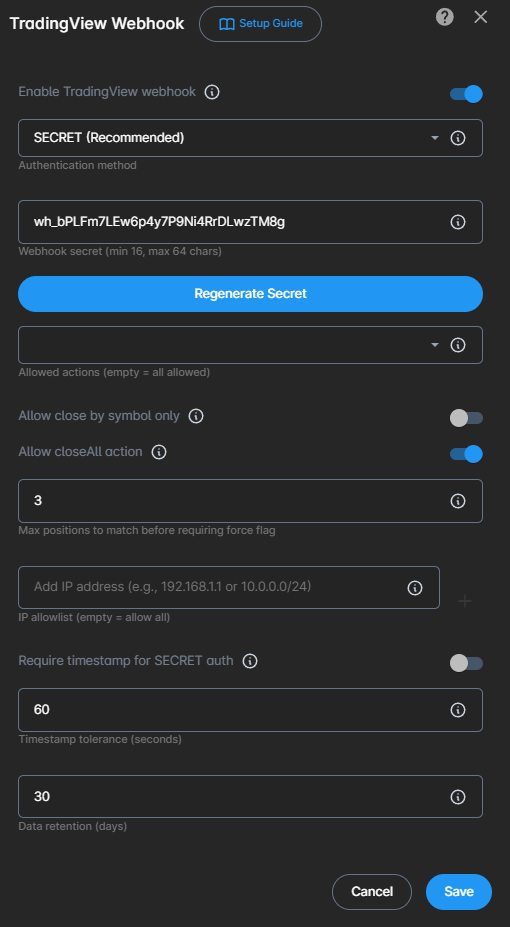
When troubleshooting any webhook issue, check the **Logs** and **Audit Logs** sections in MetaCopier. **Logs** show real-time information about trade execution, errors, and broker rejections. **Audit Logs** provide a detailed history of all actions and changes, helping you understand the sequence of events that led to an issue.
**Alert not working?**
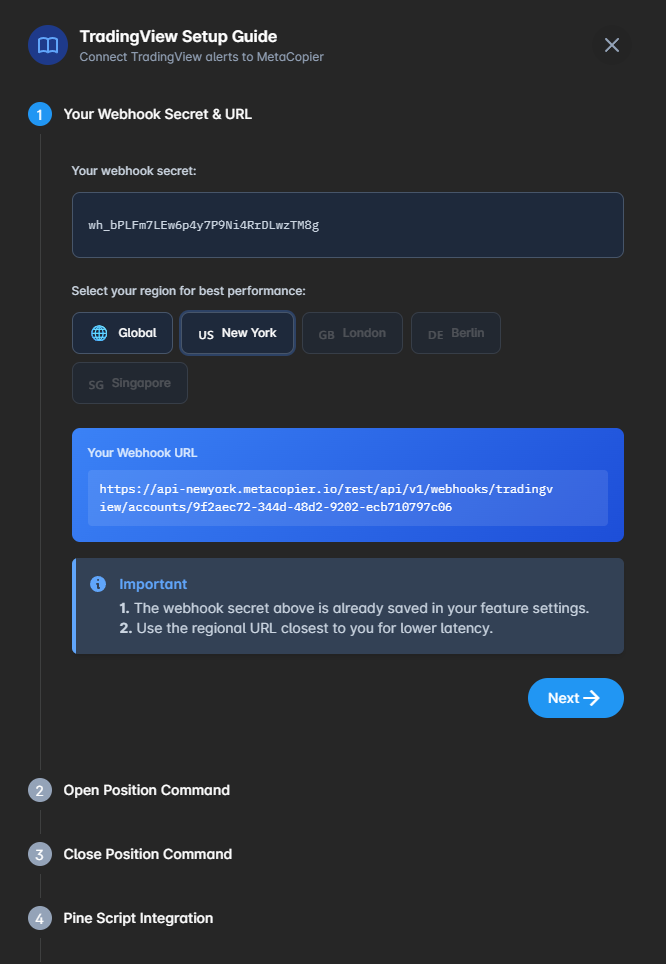
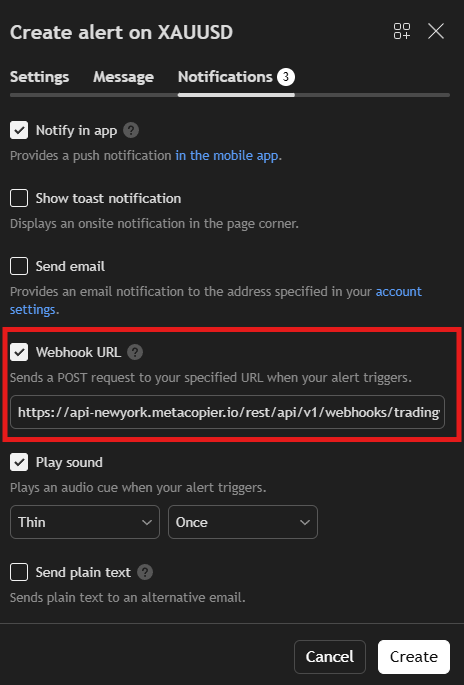
1. Check your webhook URL is correct
2. Verify your JSON is valid (use a JSON validator)
3. Confirm your secret matches exactly
4. Make sure your account is connected
**Position not found?**
1. Check the `tradeKey` spelling exactly
2. The position may already be closed
3. Use the exact same `tradeKey` you used when opening
**AMBIGUOUS\_MATCH error?**
* Add `force: true` with explicit `matchMode`
* Or add more specific filters (symbol, direction)
**HMAC signature fails?**
* Ensure timestamp is numeric (Unix seconds)
* Ensure canonical payload excludes timestamp/signature
* Ensure keys are sorted alphabetically
**Alert accepted (202) but no trade appears?**
* The webhook was queued successfully, so the problem is on the broker side. Check the account **Logs** for the rejection reason.
* If the log shows that no confirmation was received from the terminal, the order is retried automatically as long as `openRetry` is enabled. Increase `openRetryTimeoutInMinutes` if your broker is regularly slow.
* If `openRetry` is disabled, the request is sent only once and a warning entry is written immediately.
* An entry such as `Attempt 2 failed, retrying: ... - buy EURUSD 0.10` means the trade is still being retried inside the configured window. No action is needed until the final warning appears.
* A message such as `Retry window elapsed after N attempt(s)` means every attempt inside the configured window failed. In that case the underlying broker error in the same log entry is the relevant one.
**Execution reasons in the account log**
These markers are not HTTP error codes. They come from the trading terminal and appear inside the account **Logs** entries (and in the `message` field when polling `GET /requests/{requestId}/status`).
| Marker | Meaning | Retried? |
| ----------------------------- | ------------------------------------------------------------------------------------------------------------------------- | -------- |
| `BROKER_REJECTION` | No confirmation arrived from the terminal within 15 seconds. This is a timeout, not necessarily a rejection by the broker | Yes |
| `ACCOUNT_IS_NOT_CONNTECTED` | The account was offline when the request reached the terminal, nothing was sent | Yes |
| `SYMBOLS_NOT_LOADED` | The account had just reconnected and the symbol list was still loading | Yes |
| `REQUEST_IN_PROGRESS` | A previous attempt for the same order is still running | Yes |
| `REQUEST_ALREADY_PROCESSED` | The order of a previous attempt did reach the broker, so it is not sent again | No |
| `ACCOUNT_IS_READ_ONLY` | The account is set to read only or has trading disabled | No |
| `MAX_OPEN_POSITIONS_EXCEEDED` | The account's maximum open positions limit was reached | No |
| `SYMBOL_NOT_FOUND` | The symbol does not exist on the broker or is not mapped | No |
{% hint style="info" %}
Retried markers are only retried when `openRetry` is enabled and the retry window has not elapsed.
{% endhint %}
***
## Examples by Use Case
This section provides complete examples for common trading scenarios.
### Close All Positions on Account
Close every open position on the account. Useful for emergency exit or end-of-day cleanup.
**Step 1: Enable closeAll in Feature Settings**
```json
{
"allowCloseAll": true
}
```
**Step 2: Send closeAll Request**
```json
{
"secret": "your_secret_minimum_16_chars",
"action": "closeAll",
"force": true
}
```
{% hint style="warning" %}
This closes ALL positions immediately. Both `allowCloseAll: true` and `force: true` are required as safety guards.
{% endhint %}
***
### Close by Strategy Group (Magic Number)
Close all positions belonging to a specific strategy. Useful when running multiple strategies on the same account.
#### Open with Magic Number
```json
{
"secret": "your_secret_minimum_16_chars",
"action": "open",
"symbol": "EURUSD",
"orderType": "buy",
"volume": 0.1,
"magicNumber": "150001"
}
```
#### Close All Positions with Same Magic Number
```json
{
"secret": "your_secret_minimum_16_chars",
"action": "close",
"matchMode": "GROUP",
"magicNumber": "150001"
}
```
{% hint style="info" %}
This closes ALL positions with `magicNumber: "150001"`, regardless of symbol or direction.
{% endhint %}
#### Close Only Long Positions in Group
```json
{
"secret": "your_secret_minimum_16_chars",
"action": "close",
"matchMode": "GROUP",
"magicNumber": "150001",
"direction": "long"
}
```
***
### Close by Order ID (Pine Script Strategies)
Close positions by strategy entry name. Useful for Pine Script strategies using `strategy.entry()`.
#### Pine Script Strategy Example
```pine
//@version=5
strategy("My Strategy", overlay=true)
if buyCondition
strategy.entry("Long Entry", strategy.long)
if sellCondition
strategy.entry("Short Entry", strategy.short)
```
#### Alert Message (Open)
```json
{
"secret": "your_secret_minimum_16_chars",
"action": "open",
"symbol": "{{ticker}}",
"orderType": "{{strategy.order.action}}",
"volume": 0.1,
"orderId": "{{strategy.order.id}}"
}
```
#### Alert Message (Close All "Long Entry" Positions)
```json
{
"secret": "your_secret_minimum_16_chars",
"action": "close",
"matchMode": "GROUP",
"orderId": "Long Entry"
}
```
{% hint style="info" %}
`orderId` is NOT unique - all positions with the same entry name are closed.
{% endhint %}
{% hint style="warning" %}
`orderId` is matched inside the position comment, which MT4/MT5 brokers truncate to 25–31 characters. Long entry names are cut off and then no longer match. If this recipe returns `POSITION_NOT_FOUND`, send a numeric `magicNumber` on open and group by that instead. See [Truncation-Proof Grouping](#truncation-proof-grouping-magicnumber).
{% endhint %}
***
### Close by Symbol (Bulk Matching)
Close positions for a specific symbol. Requires additional filters by default.
#### Close All EURUSD Long Positions
```json
{
"secret": "your_secret_minimum_16_chars",
"action": "close",
"matchMode": "BULK",
"symbol": "EURUSD",
"direction": "long"
}
```
#### Close All EURUSD Short Positions
```json
{
"secret": "your_secret_minimum_16_chars",
"action": "close",
"matchMode": "BULK",
"symbol": "EURUSD",
"direction": "short"
}
```
#### Close ALL EURUSD Positions (Both Directions)
```json
{
"secret": "your_secret_minimum_16_chars",
"action": "close",
"matchMode": "BULK",
"symbol": "EURUSD",
"force": true
}
```
{% hint style="info" %}
Without `direction`, this matches all EURUSD positions. If more than `maxMatchCount` positions exist, `force: true` is required.
{% endhint %}
***
### Close First or Last Position (FIFO/LIFO)
Close only the oldest or newest position matching your criteria.
#### Close Oldest Position (FIFO)
```json
{
"secret": "your_secret_minimum_16_chars",
"action": "close",
"matchMode": "BULK",
"symbol": "EURUSD",
"direction": "long",
"closeMode": "first"
}
```
#### Close Newest Position (LIFO)
```json
{
"secret": "your_secret_minimum_16_chars",
"action": "close",
"matchMode": "BULK",
"symbol": "EURUSD",
"direction": "long",
"closeMode": "last"
}
```
#### Close Oldest Position in Strategy Group
```json
{
"secret": "your_secret_minimum_16_chars",
"action": "close",
"matchMode": "GROUP",
"magicNumber": "220001",
"closeMode": "first"
}
```
***
### Partial Close (Reduce Position Size)
Reduce position size without fully closing it.
```json
{
"secret": "your_secret_minimum_16_chars",
"action": "modify",
"tradeKey": "my_trade_001",
"reduceVolumeBy": 0.05
}
```
{% hint style="info" %}
**Example**: Position is 0.1 lots → `reduceVolumeBy: 0.05` → Position becomes 0.05 lots
{% endhint %}
#### Partial Close by Magic Number
```json
{
"secret": "your_secret_minimum_16_chars",
"action": "modify",
"matchMode": "GROUP",
"magicNumber": "330001",
"reduceVolumeBy": 0.01
}
```
{% hint style="info" %}
This reduces ALL positions in the group by 0.01 lots each.
{% endhint %}
***
### Using the Force Flag
The `force` flag allows closing more positions than `maxMatchCount` (default: 3).
#### When Force is Required
| Scenario | Force Required? |
| ----------------------------------- | --------------- |
| 2 positions match, maxMatchCount=3 | No |
| 5 positions match, maxMatchCount=3 | Yes |
| `closeAll` action | Always |
| Symbol-only close without direction | Yes |
#### Force with Explicit matchMode
```json
{
"secret": "your_secret_minimum_16_chars",
"action": "close",
"matchMode": "GROUP",
"magicNumber": "440001",
"force": true
}
```
{% hint style="info" %}
**Important**: `force: true` requires an explicit `matchMode`. Auto-detected matchMode with force will be rejected with `FORCE_REQUIRES_EXPLICIT_MODE`.
{% endhint %}
***
### Real-World Strategy Examples
#### Grid Trading Strategy
Open multiple positions with the same magic number, close oldest first:
**Open (multiple grid levels)**
```json
{
"secret": "your_secret_minimum_16_chars",
"action": "open",
"symbol": "EURUSD",
"orderType": "buy",
"volume": 0.01,
"magicNumber": "220002",
"tradeKey": "grid_EURUSD_{{timenow}}"
}
```
**Close Oldest Grid Position (Take Profit)**
```json
{
"secret": "your_secret_minimum_16_chars",
"action": "close",
"matchMode": "GROUP",
"magicNumber": "220002",
"closeMode": "first"
}
```
**Close All Grid Positions (Emergency Exit)**
```json
{
"secret": "your_secret_minimum_16_chars",
"action": "close",
"matchMode": "GROUP",
"magicNumber": "220002",
"force": true
}
```
***
#### Multi-Symbol Strategy
Trade multiple symbols with the same strategy:
**Open Position**
```json
{
"secret": "your_secret_minimum_16_chars",
"action": "open",
"symbol": "{{ticker}}",
"orderType": "{{strategy.order.action}}",
"volume": 0.1,
"magicNumber": "550001",
"tradeKey": "trend_{{ticker}}_{{timenow}}"
}
```
**Close Specific Symbol**
```json
{
"secret": "your_secret_minimum_16_chars",
"action": "close",
"matchMode": "BULK",
"symbol": "{{ticker}}",
"direction": "long"
}
```
**Close All Strategy Positions (All Symbols)**
```json
{
"secret": "your_secret_minimum_16_chars",
"action": "close",
"matchMode": "GROUP",
"magicNumber": "550001",
"force": true
}
```
***
#### Scalping Strategy with Take Profit Levels
Open with tradeKey for precise control:
**Open Position**
```json
{
"secret": "your_secret_minimum_16_chars",
"action": "open",
"symbol": "{{ticker}}",
"orderType": "buy",
"volume": 0.3,
"stopLoss": 1.0850,
"takeProfit": 1.0950,
"tradeKey": "scalp_{{ticker}}_{{timenow}}"
}
```
{% hint style="info" %}
TradingView placeholders don't support math operations. Use fixed prices or calculate SL/TP in your Pine Script using `strategy.order.alert_message`.
{% endhint %}
**Partial Close at First Target (1/3)**
```json
{
"secret": "your_secret_minimum_16_chars",
"action": "modify",
"tradeKey": "scalp_{{ticker}}_{{timenow}}",
"reduceVolumeBy": 0.1
}
```
**Move Stop Loss to Break Even**
```json
{
"secret": "your_secret_minimum_16_chars",
"action": "modify",
"tradeKey": "scalp_{{ticker}}_{{timenow}}",
"stopLoss": 1.0880
}
```
{% hint style="info" %}
**Tip**: For dynamic SL/TP based on entry price, use `strategy.order.alert_message` in your Pine Script to pass calculated values.
{% endhint %}
**Close Remaining Position**
```json
{
"secret": "your_secret_minimum_16_chars",
"action": "close",
"tradeKey": "scalp_{{ticker}}_{{timenow}}"
}
```
***
### Symbol-Only Close (Advanced)
Close all positions for a symbol without direction filter. Requires special permission.
**Step 1: Enable in Feature Settings**
```json
{
"allowSymbolOnlyClose": true
}
```
**Step 2: Close All Symbol Positions**
```json
{
"secret": "your_secret_minimum_16_chars",
"action": "close",
"matchMode": "BULK",
"symbol": "EURUSD",
"closeMode": "all"
}
```
{% hint style="info" %}
**Note**: Without `allowSymbolOnlyClose: true`, you must include `direction` or another filter.
{% endhint %}
***
### Using Dynamic Values (Advanced Pine Script)
TradingView placeholders don't support math operations. To use calculated values (like dynamic SL/TP), use the `alert_message` parameter in your Pine Script.
**Pine Script Example:**
```pine
//@version=5
strategy("Dynamic SL/TP Strategy", overlay=true)
// Calculate dynamic SL and TP
entryPrice = close
stopLoss = entryPrice * 0.998 // 0.2% below entry
takeProfit = entryPrice * 1.005 // 0.5% above entry
// Build the JSON message
alertMsg = '{"secret": "your_secret_minimum_16_chars", "action": "open", "symbol": "' + syminfo.ticker + '", "orderType": "buy", "volume": 0.1, "stopLoss": ' + str.tostring(stopLoss) + ', "takeProfit": ' + str.tostring(takeProfit) + ', "tradeKey": "trade_' + syminfo.ticker + '_' + str.tostring(timenow) + '"}'
if buyCondition
strategy.entry("Long", strategy.long, alert_message=alertMsg)
```
**Alert Message (uses the dynamic values):**
```json
{{strategy.order.alert_message}}
```
When the alert triggers, TradingView replaces `{{strategy.order.alert_message}}` with the complete JSON containing the calculated SL/TP values.